
Microglia may be the missing clue to solve the opioid epidemic
Read now →These tiny cells have the machinery to sense opioids, and targeting them may relieve opioid addiction
These tiny cells have the machinery to sense opioids, and targeting them may relieve opioid addiction

Neuroscience
Université de Bordeaux

Photo by Christian Erfurt on Unsplash
Chronic Fatigue Syndrome (CFS), also known as myalgic encephalomyelitis/chronic fatigue syndrome (ME/CFS), has its first blood-based diagnostic test thanks to the efforts of Dr. Ron Davis. Dr. Davis launched the Stanford Chronic Fatigue Syndrome Research Center in 2013, after his son, Whitney, developed the devastating and debilitating illness.
While there are an estimated 2 million people in the US living with ME/CFS, many patients go for years without a diagnosis, which they get only after other disease possibilities have been eliminated. Dr. Davis and his team developed a nanoelectric assay, which can measure minuscule changes in energy, to test the effects of stress on immune cells and plasma. The change in electrical activity is directly correlated with the health of the sample, therefore allowing Dr. Davis' team to accurately distinguish the cells from ME/CFS patients from healthy controls. While more research efforts are needed to accurately diagnose and treat this illness in clinic, this is one of the first biomarkers for ME/CFS identified. These results from Dr. Davis' team prove that this illness is not made up in the patients' heads, but identifiable in their blood.
Neuroscience
Université de Bordeaux
Via Wikimedia
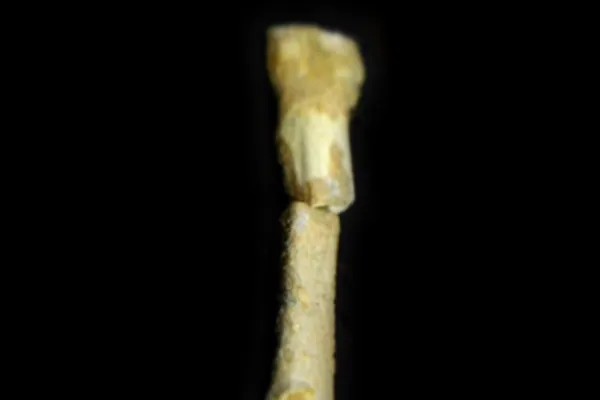
Recently, a team of international researchers have discovered a new human species, Homo luzonensis, in the Philippines. Their first discovery was in 2007, when they came across an unusual small foot bone - a metatarsal - dating back to 67,000 years ago. This bone was found in Cagayan Valley on the island of Luzon, on the protected lands of the indigenous Aeta people. This fossil was the earliest direct proof of humans living in the Philippines, but analysis could not determine which species of “Homo” it belonged to. After further excavation, the researchers found more strange remains from what they determined to be 3 individuals - at least two adults and one child.
However, not everyone is convinced by this discovery. They argue that there is not enough evidence that this is a new species of human, especially because the fossils were all broken or heavily worn down. They claim more tests need to be done before naming a new species.
The interdisciplinary team has already used all the non-destructive tests available including 3D analysis and x-ray imaging to distinguish the different morphological characteristics, but further analysis is still needed to learn more about this species’ behavior or biology.
This discovery reaffirms how important the islands of Southeast Asia are for understanding the evolution of our species. Within the last few decades, the number of different known species from human fossils has almost tripled. As researchers work to unearth the diverse roots of our family tree, what will they find next?

Palliative care can increase the quality of life for all patients