Rogue planets' moons could harbor liquid water — and life
A new modelling study points to another place in space where life could flourish
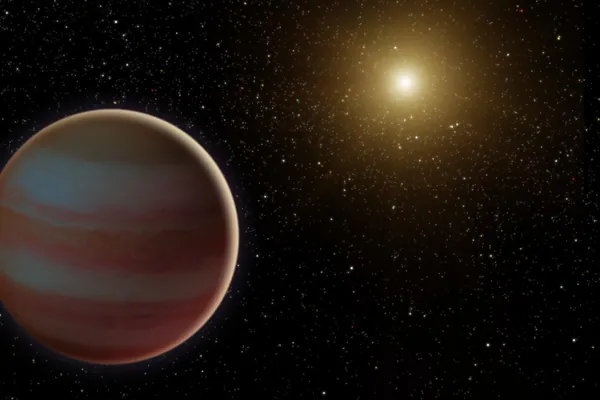
When we think of planets we picture them orbiting a star, like Earth orbits the Sun. But there actually may be billions of starless planets floating around our galaxy, either ejected from their system or formed independently. These are called rogue (or free-floating) planets.
Even though scientists have never detected one of these objects, they are theorizing about their properties. We know, for example, that rogue planets may retain their moons even after being ejected from their native system. Could these satellites, under the right conditions, host liquid water and also life?
A new study published in the International Journal of Astrobiology explores this possibility. The researchers modelled a hypothetical case of a Jupiter-sized rogue planet with an Earth-sized moon and followed the evolution of this system to study how it might behave. Even without a central star, heat could be created by the tidal forces that a rogue planet exerts on its moon, while its atmosphere could be affected by cosmic particles that are usually deflected by a star's magnetic field.
Adjusting the orbit of the hypothetical moon, the composition of its atmosphere, and the amount of particles that reach its surface reveals that, with the right set of parameters, a rogue planet's moon could harbor a significant amount of liquid water, potentially enough to sustain life. These conditions would have to be satisfied for a long time for life to have a chance, but this study suggests that if the system is stable enough it might be possible. These findings give scientists yet another place to look for life in outer space.