The coronavirus testing kit, explained
Issues with the initial designs and bureaucratic incompetence

Comparative Physiology
Wilfrid Laurier University
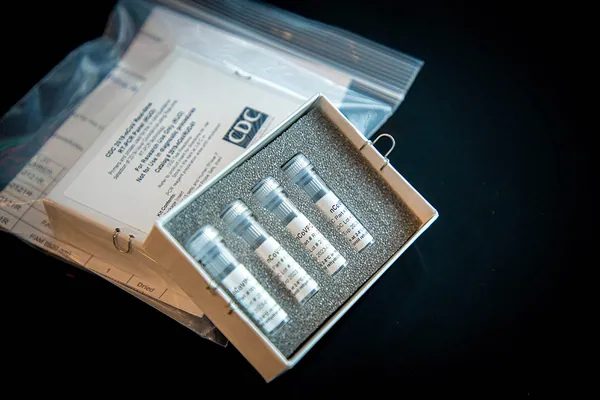
What is a COVID-19 testing kit, and how does it work?
When someone tests positive for the COVID-19 (coronavirus) disease, it means that RNA from SARS-CoV-2, the virus that causes COVID-19, was detected from samples taken from their body. Samples can include swabs taken from the nose, throat, or sputum from a cough.
Both humans and SARS-CoV-2 have RNA. RNA is like DNA, except it is shaped as a single strand folded onto itself instead of a double helix. Some viruses used RNA to store genetic information, like humans use DNA.
[PRODUCTION NOTE – DNA vs RNA image]
COVID-19 test kits detect RNA sequences that are only found in coronaviruses, but not humans. The CDC kit detects the gene for the part of the virus that houses its genome, which is often unique to each virus. The Pubic Health Ontario kits detect the gene for the virus's genome replication machinery or a gene involved in creating the virus's outer envelope.
COVID-19 detection kits rely on a technique called real-time reverse transcriptase polymerase chain reaction (real-time RT-PCR). This is a well-established and reliable technique to detect RNA in a biological sample.
First, the RNA is separated from the other materials in the sample, like proteins. The amount of RNA in a clinical sample is very small, so we need to amplify (make more) of it to detect it in a standard test. However, making more RNA is difficult because it breaks down very easily.
To get around this, scientists make DNA copies of the RNA sequence. DNA is much more stable than RNA. The protein that makes DNA copies of RNA is called reverse transcriptase.
Once the information in the purified RNA is translated into DNA, scientists can use the PCR reaction to make more DNA, so they can detect the information contained in the original biological sample.
The PCR reaction involves 4 main pieces: DNA, DNA polymerase protein, primers to guide that protein, and raw material for making DNA, called nucleic acids.
[PRODUCTION NOTE – FIND A NICE DIAGRAM OF THIS]
The DNA is heated to 95oC. This causes the DNA it to split into two single strands, instead of its familiar double helix.
The temperature is then lowered to about 80oC, which is warm enough to keep the DNA separated, but cool enough for the primers to bind to the single stranded DNA.
Primers are short strings of DNA bases that bind to specific DNA sequences, like a nucleocapsid (N) gene. Primers are like road signs for the DNA polymerase that tell it where to go.
With the primers attached, the temperature increases to 72oC, which is the temperature where the DNA polymerase protein works best. DNA polymerase fills in the missing DNA bases around the primers by using the raw nucleic acids in the mix, producing double-stranded DNA.
At the end of one PCR cycle, there are twice as many copies of the gene as before.
The cycle is then repeated about 40 times - two strands becomes four, then eight, then sixteen, and so on. Billions of copies of a DNA sequence are created in a standard PCR run.
The difference between real-time PCR, which is used to detect COVID-19, and traditional PCR is that real-time PCR also uses a fluorescent probe that reacts to the amount of DNA in the sample. By tracking the increase in fluorescence during each cycle of the PCR reaction, scientists can watch the DNA copies increase in real time, instead of testing after an arbitrary number of cycles.
With each cycle, the fluorescence signal grows stronger because there are more copies for the probe to detect. For the CDC kit, someone is a presumptive positive for COVID-19 if the amount of fluorescence reaches a pre-determined threshold value within 40 PCR cycles. If someone is tested but is not infected with SARS-CoV-2, then the fluorescence signal remains below the threshold value after 40 PCR cycles.
What does it mean that some kits are contaminated?
A typical RT-PCR kit includes positive, negative, and extraction controls. Scientist know what to expect from these control samples, and use them to make sure the kit is performing correctly.
The positive control in the CDC kit is a non-infectious version of RNA from the novel coronavirus (2019-nCoV). It should have a positive result (e.g. above threshold fluorescence after 40 PCR cycles) for the COVID-19 and RNase P markers
The negative control in the CDC is sterile water (called the no template control, NTC). It is used to check for contamination, and should have a negative result for all markers (e.g. below threshold fluorescence after 40 PCR cycles).
The extraction control in the CDC kit is made from non-infectious cultured human cells (called the Human Specimen Control, HSC). It is used to check that the RNA was extracted correctly, and that all the test chemicals are working. It should also have a negative result for the COVID-19 markers (since there is no viral RNA in the sample), but a positive result for the RNase P marker (since there is human DNA in this sample).
If a positive, negative, or extraction control does not behave as expected, then the scientist knows that the result of the assay is not reliable, and the test needs to be redone.
The initial roll out of the CDC kit was marred by reports of kit contamination due to a faulty negative control reagent. A kit is said to be contaminated when the negative control cannot be distinguished from the positive control (e.g. both set of control samples exceeded the threshold for the COVID-19 and RNase P markers). Contamination can result from improper manufacturing of reagents by the company or poor handling of the reagents by lab personnel.
What supplies are in global shortage?
RT-PCR has several steps, and each involves a fair number of specialized resources, including least two kits – one for extracting the RNA, and one for performing the real-time RT-PCR.
Currently, there are global shortages of RNA extraction kits, including the Qiagen QIAamp Viral Mini Kit, the Qiagen EZ1 Virus Mini-Kit, and the Roche MagnaPure nucleic acid kit.
Without these reagents, COVID-19 testing cannot be performed because RNA cannot be extracted from clinical samples. There is no material to put through the RT-PCR reaction.
Other RNA extraction kits exist, but their adoption by US labs may be limited. The Roche RNA extraction kit, which was approved by the CDC later, uses different equipment than the Qiagen kit. Not all labs may have this equipment.
The CDC recently updated it’s guidelines to allow labs to combine nose and throat samples into one test to reduce the number of kits required for each case.
Why can’t labs make a custom kit?
Research labs can and often do make their own RT-PCR kits, as it can be less expensive than ordering a premade kit, like how cooking at home is cheaper than going out for dinner.
Most of RT-PCR reagents are interchangeable between RNA sequences, and many reagents are common in molecular biology labs. These include a master mix of materials for making DNA, sterile water, RNA extraction kits, PCR plates, a thermocycler, reverse transcriptase, and other materials.
The part of the RT-PCR kit that makes it recognize COVID-19 and not something else, like HIV or smallpox, is the primer. Designing primers that react to the DNA sequence of interest is critical to the success of a RT-PCR test.
Researchers can use programs like the NIH’s Primer-BLAST database to identify primers for the sequence they want to amplify. The COVID-19 kit primers are available on the CDC website, and World Health Organization (WHO) maintains a catalogue of its primers and protocols as well.
But the use of custom kits is limited by red tape. The FDA’s emergency use approval is required before kits can be used for COVID-19 testing.
Currently, only the 2019-nCOV Real-Time RT-PCR Diagnostic Panel (CDC) and the New York SARS-CoV-2 Real-time Reverse Transcriptase (RT)-PCR Diagnostic Panel (Wadsworth Center, NYSDOH) meet this criteria.
The FDA recently revised this policy to make it easier for outside labs to design and conduct their own validated tests.
The Mayo Clinc announced on March 12th that is has developed a test capable of detecting SARS-CoV-2, though whether it will received FDA approval or be widelt adopted remains to be seen.
Who can get tested for COVID-19?
Current CDC guidelines suggest testing only if someone fills two criteria. Firstly, they must show symptoms consistent with COVID-19, like fever or breathing problems. Secondly, they must have been in close contact with someone known to have COVID-19 and/or that have recently been to an area with ongoing spread of COVID-19.
The CDC recommends that people who fulfill both criteria contact their doctor to determine if they should be tested. However, even a request for testing from a patient’s doctor does not guarantee they will be tested.
These stringent testing criteria mean it is entirely possible for COVID-19 to be spread through a community without being detected (i.e. if criteria #2 cannot be determined). It’s also a lot of hoops for someone to jump through to get tested and makes it very difficult for people without insurance to get tested.
Why is testing in the US so slow, and why does it matter?
The US response to COVID-19 stumbled out of the gate with faulty kits, and a continued lack of kits across the country. The development of new kits allowed by the relaxation of FDA policy may help ease this problem.
Testing capacity also remains uneven across the country – as of March 6th, California claimed it could test over 6,000 people per day, whereas Hawaii and Arkansas can barely break the double digits.
Personnel shortages are also a problem. Conducting a RT-PCR test takes time, expertise in molecular biology, and expensive equipment. There may not be enough hours or thermocyclers available to meet demand. For example, the Dean of the University of Washington’s medical school put out a call for graduate students to help run COVID-19 lab tests.
Where can I find more information about COVID-19 test kits?
The US Centers for Disease Control and Prevention (CDC) has an online FAQ for laboratories. Public Health Ontario (PHO), the largest province in Canada, also has a webpage detailing proper testing protocols.
Specific instructions for the CDC 2019-Novel Coronavirus (2019-nCoV) Real-Time RT-PCR Diagnostic Panel are available here.